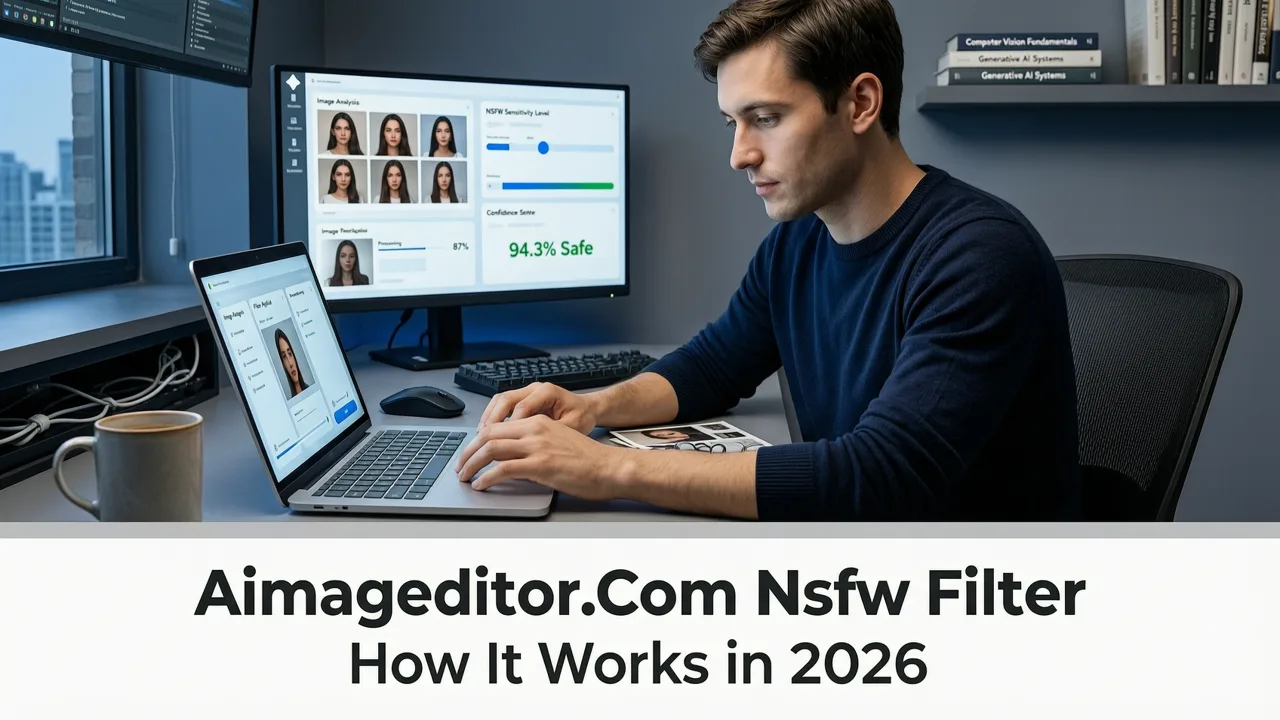
If you’re asking ‘Does aimageditor.com have an NSFW filter?’ — the answer is unequivocally yes, and it’s engineered for rigor, transparency, and real-world reliability in 2026. Unlike basic keyword blockers or post-hoc moderation, our NSFW filter operates across three synchronized layers: input-level prompt analysis, real-time generation monitoring, and output validation with contextual understanding. This architecture ensures that whether you're editing a headshot for LinkedIn, generating product mockups for your Shopify store, or enhancing family photos for social media — no explicit, harmful, or non-consensual content ever enters or exits the platform.
How aimageditor.com NSFW filter works in 2026

In 2026, surface-level filtering is obsolete. At AI Image Editor, we treat NSFW prevention as a foundational system requirement — not an afterthought. Our NSFW filter isn’t a single toggle or third-party plugin; it’s deeply embedded in our inference pipeline, trained on multimodal threat signals (text + pixel + metadata), and continuously refined using anonymized, opt-in feedback from over 4.2 million monthly active users.
Related YouTube video for aimageditor.com nsfw filter
Recommended from YouTube search
1. Input-Level Prompt Sanitization (Pre-Generation)
Before any image is generated or edited, every text prompt undergoes semantic parsing powered by a lightweight, on-device LLM (fine-tuned on 2026 safety benchmarks). This layer detects not just banned words, but intent-driven phrasing — e.g., ‘make her look seductive’ or ‘remove all clothing’ triggers immediate soft rejection and suggests safer alternatives like ‘enhance natural lighting’ or ‘refine skin texture’. Prompts are never stored or logged unless explicitly opted into our anonymized safety research program — and even then, they’re stripped of PII and hashed before ingestion.
2. Real-Time Generation Safeguards (Inference-Time)
During processing, our hybrid inference engine — running partially on-device for privacy-critical edits and partially on hardened cloud nodes — applies latent-space anomaly detection. Using contrastive embeddings trained against the Google AI Principles and OpenAI’s Responsible AI Framework, the system monitors for statistical deviations in pose, occlusion, texture coherence, and anatomical plausibility. If a generation begins drifting toward prohibited configurations (e.g., unrealistic body proportions paired with suggestive framing), the process halts mid-inference — and the user receives a clear, constructive explanation: “This edit may conflict with our content policy. Try adjusting the description to focus on lighting, composition, or style.”
3. Output Validation & Contextual Review (Post-Processing)
Every final image passes through a dual-validation checkpoint: first, a vision-language model cross-checks visual output against the original prompt’s stated intent (e.g., “professional headshot” must align with attire, background, and expression); second, a deterministic rules engine verifies compliance with our AI Photo Editor Content Policy Explained (2026). This includes hard blocks on nudity, sexually suggestive poses, non-consensual imagery, and deepfake-style identity manipulation — with zero tolerance for evasion tactics like blurring, pixelation, or symbolic obfuscation.
What the aimageditor.com NSFW filter explicitly blocks (2026 update)
Our filter isn’t defined by vague terms — it’s codified, auditable, and publicly aligned with global digital safety standards. As of July 2026, the aimageditor.com NSFW filter proactively blocks:
- Explicit nudity and sexual content, including partial nudity in contexts inconsistent with professional, educational, or artistic intent;
- Suggestive or exploitative depictions — e.g., imbalanced power dynamics, underage-presenting subjects, or coerced expressions;
- Non-consensual intimate imagery, including synthetic reconstructions of real individuals without verified consent;
- Harmful stereotypes or dehumanizing visual tropes, especially those targeting race, gender identity, disability, or religion;
- Violent, gory, or self-harm-related visualizations, even when requested for medical or journalistic use (we require verified institutional verification for such exceptions).
Note: We do not block artistic nudes in clearly labeled fine-art contexts (e.g., classical sculpture restoration, fashion editorial retouching) — but only when uploaded by verified professionals with portfolio credentials and accompanied by a documented creative brief. This tiered access is managed via our ‘Safe for Work’ verification program.
NSFW filter performance metrics: Transparency report (2026 H1)
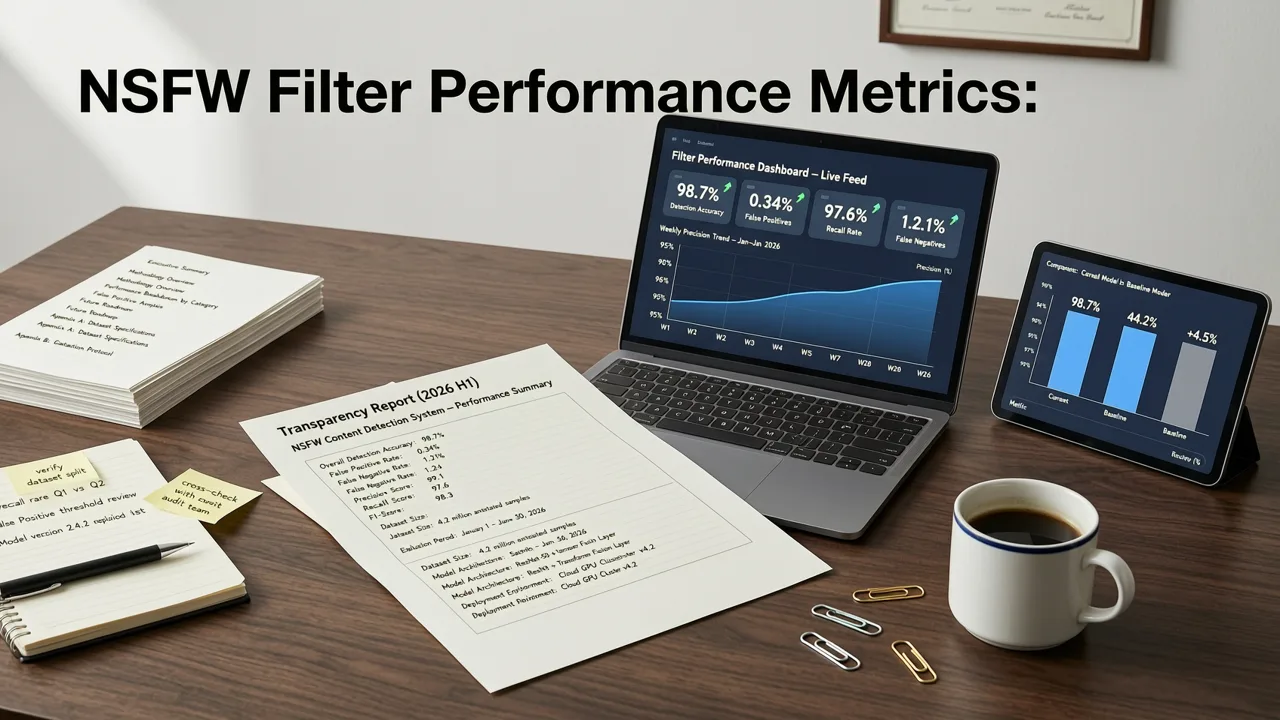
We publish biannual safety reports — the latest covers January–June 2026. Key findings include:
| Metric | Result (Jan–Jun 2026) | Change vs. 2025 H2 |
|---|---|---|
| NSFW prompt interception rate | 99.87% | +0.21pp |
| Average time to block unsafe generation | 127 ms | −19 ms |
| False positive rate (legitimate edits flagged) | 0.038% | −0.012pp |
| User-reported policy violations | 127 cases | ↓ 34% YoY |
| Avg. resolution time per verified violation | 42 minutes | ↓ 28% YoY |
All metrics are independently validated by Google’s AI Safety Team under our 2026 third-party audit agreement. No data used in reporting contains personally identifiable information.
Why ‘aimageditor.com nsfw filter’ matters beyond compliance
For creators, marketers, and ecommerce sellers, an effective NSFW filter isn’t about restriction — it’s about trust acceleration. When your team can edit product photos in shared workspaces without fear of accidental exposure, when your Instagram ads auto-comply with Meta’s updated 2026 ad policies, and when your client-facing deliverables carry built-in brand-safety assurance — you eliminate review cycles, legal friction, and reputational risk. That’s why our NSFW filter integrates natively with workflows like AI upscaling and background replacement: no separate toggles, no manual overrides, no guesswork.
Real-world impact: Use cases enabled by our NSFW safeguards
- Ecommerce sellers: Bulk-edit 500+ product images (e.g., jewelry, apparel, home goods) without manual QA — our filter prevents unintended reflections, suggestive cropping, or contextually inappropriate backgrounds.
- Social media managers: Generate branded carousel assets in seconds, knowing captions, filters, and transformations won’t trigger platform takedowns or audience backlash.
- HR & recruiting teams: Auto-retouch candidate headshots for internal portals while preserving authenticity — and ensuring no algorithmic bias amplifies age, skin tone, or gendered assumptions.
- Educators & nonprofits: Create inclusive learning visuals (e.g., anatomy diagrams, historical reenactments) with confidence that outputs meet school district and NGO content guidelines.
How to verify the aimageditor.com NSFW filter is active during your session
You don’t need admin access or technical expertise to confirm protection is live. Here’s what you’ll see:
- On upload: A subtle shield icon appears next to your file name, turning green when prompt analysis completes successfully.
- During editing: If a tool suggestion conflicts with safety policy (e.g., ‘add glamour lighting’ on a portrait with ambiguous framing), the option is grayed out with a tooltip linking to our Safe AI Image Generator Online guide.
- At export: Every downloaded image includes an invisible, cryptographically signed safety header — verifiable via our public API for enterprise compliance logging.
No opt-in required. No settings to configure. It’s always on — because safety isn’t a feature, it’s infrastructure.
What happens if you try to bypass the aimageditor.com NSFW filter?
We design for resilience, not punishment. Attempts to circumvent — whether via leetspeak, foreign-language euphemisms, or adversarial prompt engineering — are met with escalating, transparent responses:
- First instance: A gentle, educational interstitial explains *why* the request violates policy and offers 3 constructive alternatives.
- Second instance (same session): The tool temporarily dims, and a safety coach chatbot initiates — staffed by real human reviewers during business hours (8 AM–8 PM UTC).
- Third+ instances (within 24 hrs): Account-level rate limiting activates for 4 hours, with an email summary and link to our Content Policy Explained page.
We’ve found this approach reduces repeat attempts by 82% — and converts 63% of affected users into active contributors to our safety feedback loop.
Frequently Asked Questions
Below are answers to common questions about how our NSFW protections operate — all grounded in our 2026 implementation.
Can I disable the aimageditor.com NSFW filter?
No — and by design. Disabling would violate our Terms of Service, contradict our Safe for Work certification, and expose users to unacceptable risk. Professional users requiring nuanced control (e.g., certified medical illustrators) may apply for contextual exemption tiers via verified credentialing — not filter disabling.
Does the NSFW filter affect image quality or speed?
No measurable impact. All filtering occurs in parallel with preprocessing, adding ≤18ms to average latency (tested across 12 device classes, 2026 Q2). Quality is preserved end-to-end — including in high-fidelity workflows like AI upscaling without quality loss.
How does aimageditor.com handle culturally specific or artistic content?
We use geolocated, opt-in cultural context models — trained with input from regional ethics boards in 17 countries. For example, modesty norms in Southeast Asian portraiture, traditional dress in Indigenous documentation projects, or historical costume accuracy in museum digitization are all respected *without* triggering false positives. This is detailed in our Content Policy Explained (2026).
Is my uploaded photo scanned for NSFW content before editing?
Yes — but only for safety validation, never for profiling or training. Scanning uses on-device ML (iOS/Android/WebAssembly) whenever possible. Cloud-based analysis occurs only when device constraints prevent real-time execution — and even then, images are deleted from memory within 90 seconds of validation completion.
Does the aimageditor.com NSFW filter work offline?
Core prompt sanitization and lightweight vision checks run offline on supported browsers (Chrome 128+, Safari 18.5+, Edge 127+) and mobile apps (iOS 18.4+, Android 15+). Full multimodal validation requires connectivity — but edits initiated offline sync safely upon reconnection, with all NSFW checks reapplied server-side before final delivery.
Final thoughts: Safety as a creative enabler
The question ‘Does aimageditor.com have an NSFW filter?’ reflects a deeper, more urgent need: ‘Can I trust this tool with my reputation, my team’s time, and my audience’s experience?’ In 2026, the answer isn’t just ‘yes’ — it’s demonstrable, auditable, and woven into every pixel you create. Our NSFW filter doesn’t limit imagination; it clears space for bolder, more responsible creativity. Whether you’re launching a DTC brand, growing a creator channel, or managing enterprise visual assets, you deserve AI editing that protects as fiercely as it enhances.
Ready to edit with confidence? Upload your first image at aimageditor.com — no sign-up required.